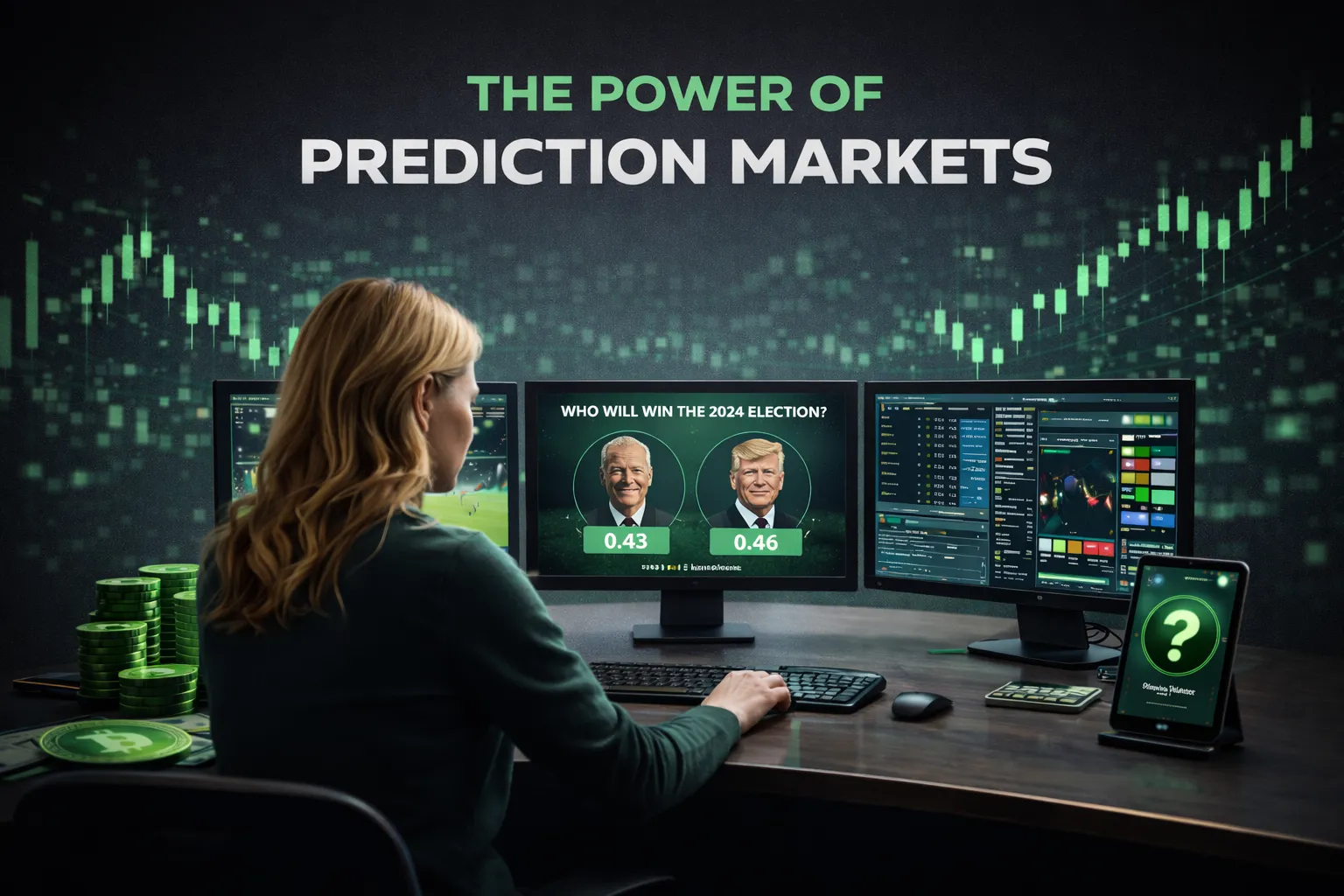
What are decentralized prediction markets?
In prediction markets, people trade on the outcomes of future events. Decentralized markets use blockchain protocols to run those trades, making activity visible on a public ledger and reducing reliance on a central authority.
For a binary share that pays $1 if the event occurs and $0 otherwise, a $0.60 price implies roughly a 60% probability before fees. If you estimate a 70% chance, you may consider buying, but your estimate can be wrong and you can lose the amount paid. In a traditional sportsbook, you place the bet against the bookmaker.
Why market prices reflect what traders know
Market prices reflect what traders know and expect. This is an example of Hayek’s "price mechanism": people act on their information, and their trades affect the price. Because their money is at stake, traders have a reason to seek accurate information.
Combining information
The market price combines different views into one estimate of probability.
Responding to news
Prices can respond to new information before traditional news outlets report it.
Questioning assumptions
The risk of losing money gives traders a reason to question their own biases.
Prediction market protocols
These examples illustrate different approaches to markets and disputes. Check current documentation, availability and eligibility before using a service.
Polymarket
Polymarket runs on Polygon and has markets covering politics, pop culture, and other events.
Augur
Augur was an early prediction market protocol. Its design used REP token holders to report results and resolve disputes.
Zeitgeist
Zeitgeist is built in the Polkadot ecosystem. It supports "futarchy," a form of governance that uses prediction markets to help organizations make decisions.
Hedging and forecasting
Individuals and organizations can also use prediction markets to hedge risks or forecast outcomes:
- A farmer might hedge against drought, or a tech company might hedge against a failed regulatory approval.
- Companies can use internal prediction markets to estimate project completion dates or sales results alongside management reports.
- Governments could use prediction markets to estimate the effects of proposed policies before putting them into practice.
How prediction markets relate to crypto betting
Crypto betting and decentralized prediction markets share blockchain infrastructure. Sports bets usually depend on the final result, while prediction markets let people trade shares as the probability changes. For more on sports wagers, read our crypto betting guide.
Check the market’s depth
Check the orders available at different prices. In a thin market, one large order can distort the implied probability. Market prices are estimates, not reliable measures of the true probability. You can also browse event forecasts on PredStack.